
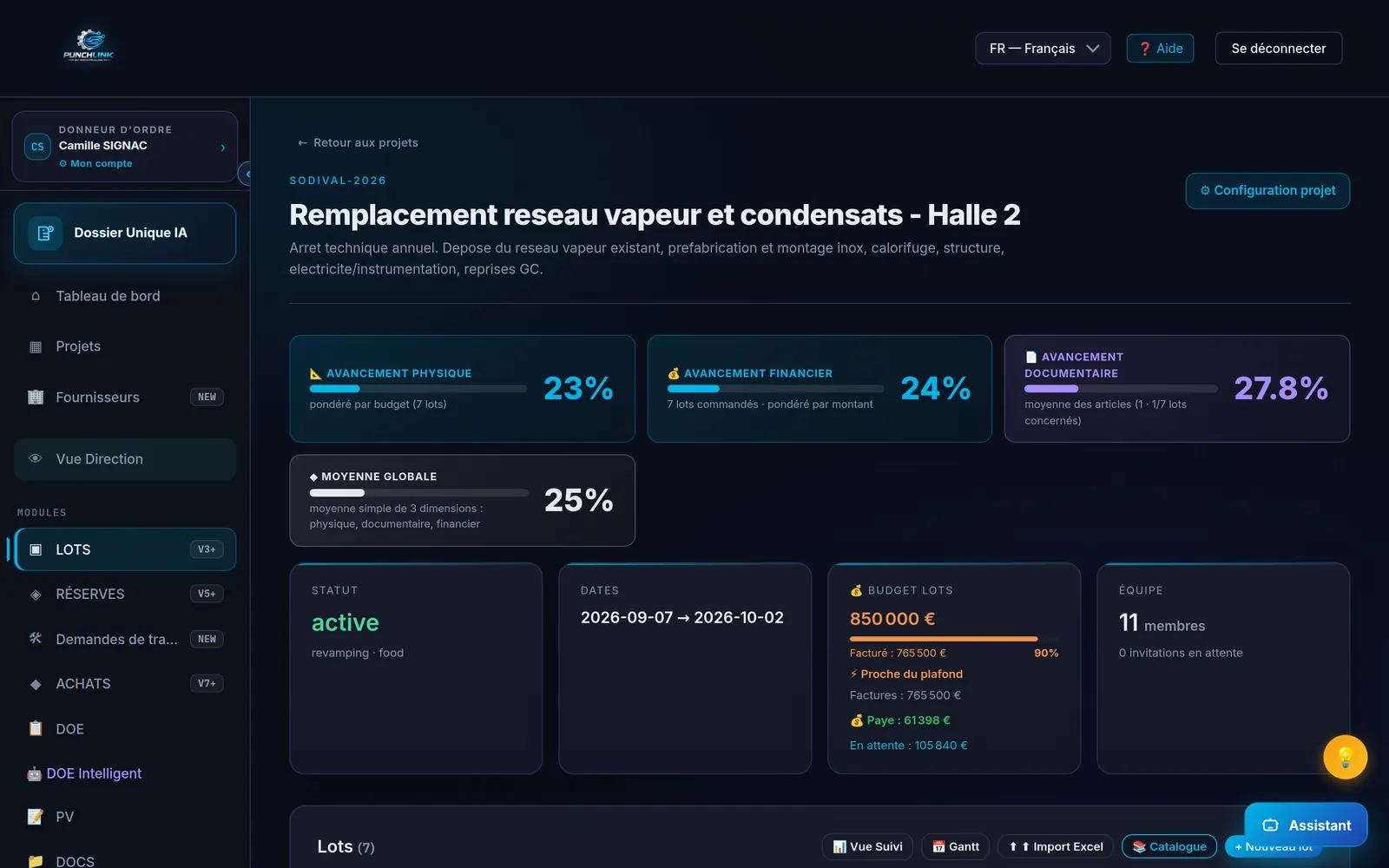
Live screenshot — PunchLink project view (demonstration project: physical, financial and documentary progress, budget, punch items)
Why this comparison exists
On petrochemical and chemical unit shutdowns you will meet e-ASY®: a “database and web & mobile application generator” published by Parlym Project Management (formerly Asymptote) with ELIPCE Informatique, presented as the result of “35 years of experience in project management”. Shutdown supervisors are satisfied with it, and they are right to say so: during a shutdown, the tool holds.
Our question is different: once the shutdown is over and the team has gone, where do the open items and the end-of-shutdown file live? That is where the two tools diverge — by nature, not by feature list.
What e-ASY announces, and does well
- A no-code generator: databases, forms, workflows (“remaining-work management”), bulk import/export, reporting and dashboards, document management, QR code / RFID, web services, WBS/OBS/EPS structuring, notifications.
- The shutdown field: Android and iOS apps, offline operation with a synchronisation module, announced use cases “progress logbooks”, “QA/QC acceptance tables”, “piping inspection plans”, “QHSE”, “additional works”, “punch list and acceptance reports management”.
- A package with the service: SaaS provisioning, needs analysis, database implementation, profiles and access rights, user and data import, support and maintenance, sovereign cloud.
- Shutdown references at large oil and chemical sites, listed on the publisher's page.
Within that scope — quickly building, for one shutdown, an application cut to the site's needs — e-ASY is legitimate and PunchLink does not try to replace it.
What differs by nature
1. A consulting project, or a product
e-ASY is delivered after a needs analysis: each site gets an application configured for it by the team supporting the shutdown. PunchLink is a finished product, the same for everyone, with an imposed business model: the punch item holds the payment, the file fills up during the works. It opens in thirty seconds, without a consulting engagement, and its price is published. No price appears on the e-ASY page.
2. After the shutdown
A tool deployed with an engagement follows the engagement's calendar. PunchLink is designed to stay with the owner: items still open at restart keep living, contractors log in themselves to close their items with a counter-photo, and evidence is kept for ten years with a written reversibility commitment. What becomes of an e-ASY application after the shutdown is not described on the publisher's page: ask your Parlym contact — it is the right question.
3. The punch item and the money
In PunchLink a blocking item weighs on the package's progress statement following the logic of the French NF P 03-001 standard (net = gross × progress − retention for open items − retention guarantee), and paying 100% despite open items requires a signed justification. A link between punch items and contractor payment is not announced on the e-ASY page.
4. The handover file
PunchLink compiles the as-built handover file continuously: every test report, certificate, datasheet or closure photo is filed under its purchase order and equipment the moment it exists. e-ASY announces document management and acceptance tables; an equipment-by-equipment handover file compilation is not announced.
5. Contractors and third-party bodies
PunchLink invites contractors without per-user licences, in their language (six interface languages, translated items), and treats items raised by an inspection body as objects only the issuer can close. How external companies access an e-ASY application depends on what the site configured; the publisher's page does not describe it.
And custom forms? Let's be frank
An application generator will always beat a finished product on a very specific form: an acceptance table unique to your unit, a piping inspection plan in your own format. PunchLink does not build custom applications. It imposes a model — order, package, item, statement, acceptance, file — because that model is what keeps a site's traceability standing for ten years. If your need is a one-of-a-kind shutdown form, e-ASY is probably the right choice for the shutdown. PunchLink takes over when the item has to be valued, paid, accepted and archived.
Comparison matrix
| Criterion | e-ASY (Parlym) | PunchLink |
|---|---|---|
| Custom application generator (databases, forms, workflows) | ✓ | — |
| Deployed through a shutdown consulting engagement | ✓ | — |
| Finished product, open in 30 seconds, no needs analysis | — | ✓ |
| Public pricing | — | ✓ |
| Offline mobile with synchronisation | ✓ | ✓ |
| QR codes in the field | ✓ | ✓ |
| Mandatory counter-photo to close an item | ? | ✓ |
| Progress statements and retentions per NF P 03-001 | ? | ✓ |
| Retention computed automatically from blocking items | ? | ✓ |
| Handover file compiled continuously, per equipment | ? | ✓ |
| Test and acceptance reports attached to the equipment | ◐ | ✓ |
| Contractors invited without per-user licences | ? | ✓ |
| 6-language interface with translated items | ? | ✓ |
| Third-party body items only the issuer can close | ? | ✓ |
| MCP connector included (Claude, ChatGPT, Copilot, Cursor) | ? | ✓ |
| Evidence kept 10 years, written reversibility | ? | ✓ |
| Hosted in the European Union | ✓ | ✓ |
✓ announced by the publisher · ◐ announced in a neighbouring form (“acceptance tables”) · ? not announced on the publisher's page (asymptote.fr, consulted September 2026; as each e-ASY application is configured per site, check with Parlym) · — outside the model.
When to choose e-ASY
If your need is a shutdown application cut to your own forms, if a consulting team supports the shutdown and can build it with you, if tracking stops at restart and contractor payment is handled elsewhere: e-ASY, with Parlym's service, is probably the right choice.
When to choose PunchLink
If open items must keep living after the shutdown, at your site, with the contractors on them; if every item must weigh on the progress statement; if the handover file must exist on acceptance day and remain readable for ten years; if your contractors speak several languages and must be invited without licences; if you want a known price before talking to anyone: PunchLink was built for you. 30-day trial, no credit card.
Frequently asked questions
Does PunchLink replace e-ASY on a unit shutdown?
Not if your shutdown relies on custom forms built with Parlym: that is what e-ASY is for. PunchLink takes over where the shutdown stops: the items still open, their consequence on payment, acceptance and the handover file. Both can coexist, each in its place.
We were satisfied with e-ASY. Why look at PunchLink?
Because satisfaction is measured at restart, and the next question comes six weeks later: where are the items still open, and who is chasing the file documents? PunchLink is built for that period — the one after the shutdown team has left.
Can PunchLink be configured like e-ASY?
No. PunchLink is not an application generator. It imposes a model — order, package, item, statement, acceptance, file — with settings (rigour level, retentions, branding, languages) but no free-form builder. That is a choice: traceability holds because the model does not move.
Can we know the price before contacting anyone?
Yes. PunchLink's offers and prices are published on the pricing page, with a simulator on the home page and a 30-day trial without credit card. The e-ASY page publishes no price; the package is set after a needs analysis.

Compare PunchLink to your current tool
30 minutes of personalized demo on your industrial project type. No generic presentation — we start from your real context and the tool you use today.