

Live capture — PunchLink Direction View on an industrial project in progress (~6 M€, 12 contractor packages)
What is Completion Management?
In the United States, Norway, and the United Kingdom, the Completion Management System (CMS) is a software category that has matured over 15 years. It structures the finalization phase of an industrial project: punch list (reserves), commissioning, startup, handover (acceptance), turnover (operations transfer). In French, this term is not commonly used. Instead, people speak of "reserve management", "acceptance certificate", "DOE" (Dossier des Ouvrages Exécutés / Executed Works File), "HSE". Three different terms for one subject: structuring the technical delivery of an industrial capex.
The European CMS market is currently dominated by 4-5 very enterprise-focused players (Hexagon Smart Completions, Omega 365, Aconex, Primavera Unifier) with typical deal sizes between 100k€ and 1M€/year and onboardings of 6 to 12 months. Inaccessible to SMEs, mid-market companies, and even most French industrial projects below 100M€ capex.
PunchLink opens this category for the French market while remaining affordable (from €199/month with TRIO) and deployable in 1 week, with no external consultant required.
The 6 key functions of a modern CMS
1. Punch list / contradictory reserves
Mobile field entry of discrepancies and non-conformities with mandatory contradictory photo proof for closure. PunchLink offers voice entry in 6 languages (FR, EN, DE, IT, ES, PL) directly usable by operators in PPE, without 4G thanks to full offline mode.
2. DOE / documentary handover
Continuous compilation of the Executed Works File throughout the project, with integrated regulatory standards (CODAP, ATEX, EN 13480, ICPE). Automatic AI-powered suggestions of probable missing documents. Automatic daily reminders to lagging contractors.
3. HSE traceability
Catalog of 73 qualification codes across 14 categories, digitized work permits, sanctions and expulsions documented in legally enforceable Word format. Automatic alerts before qualification expiration.
4. Payment + retention workflow
AFNOR P 03-001 master formula applied automatically: performance bond retention + retention on blocking reserves. Secured "pay 100%" override with username + password + timestamp + written justification.
5. Real-time Direction View
Live KPIs accessible on mobile and desktop by project management: progress, budget vs actual, open reserves, critical milestones. Drill-down from overall to package, phase, line item. Multi-project comparison for industrial portfolios.
6. Multilingual + offline mobile-first
Interface in 6 native languages, auto-translation of reserves between languages, complete offline mode (PWA + IndexedDB + server-side conflict resolution). Built for a mixed European job site with Polish, Italian, Romanian operators.
The hidden cost of "no CMS"
On French industrial projects that use no dedicated Completion Management tool, the hidden cost is estimated at 0.3 to 1% of total project budget. On a 50M€ capex, that represents 150 to 500k€ lost to:
- Hours of administrative work to reconstruct the DOE at project end (often 200-500 h per project)
- Startup delays due to incomplete or disputed acceptance certificates
- Contractor payment disputes without contradictory photo evidence
- Activated contractual penalties (handover delay)
- Production losses from difficult post-handover startups
Why 2026-2030 is the moment to switch
Several forces converge to make CMS tool adoption essential in France:
- Industrial decarbonization: 60 to 100 billion€ capex announced for 2024-2034 (ArcelorMittal Dunkerque, Air Liquide H2, cement makers, refineries converting to biofuels)
- France 2030 reindustrialization: 50+ new industrial sites announced under modern regulation
- Enhanced ICPE compliance: SEVESO update, CSRD, green taxonomy — increased documentary obligations
- Labor tension: multiple European contractors now essential, requiring a multilingual tool
- Insurance + audit pressure: legal traceability is non-negotiable
How to get started with PunchLink
1. Request a 30-minute demo on your real project (not generic presentation)
2. Activate free 30-day trial with no credit card, full access to all features
3. Launch a pilot with 2-hour onboarding support (vs 6-12 months consultant at enterprise players)
4. Measure ROI on the first project (typically 5 to 20× the license cost)
On a 10M€ capex and 6 months of works, PunchLink can save up to 200k€ in avoided admin hours, disputes and penalties, for a TRIO plan at €199/month or ÉQUIPE at €490/month. The math is quick.

Compare PunchLink to your current tool
30 minutes of personalized demo on your type of industrial project. No generic presentation — we start from your real context and the tool you're using today.
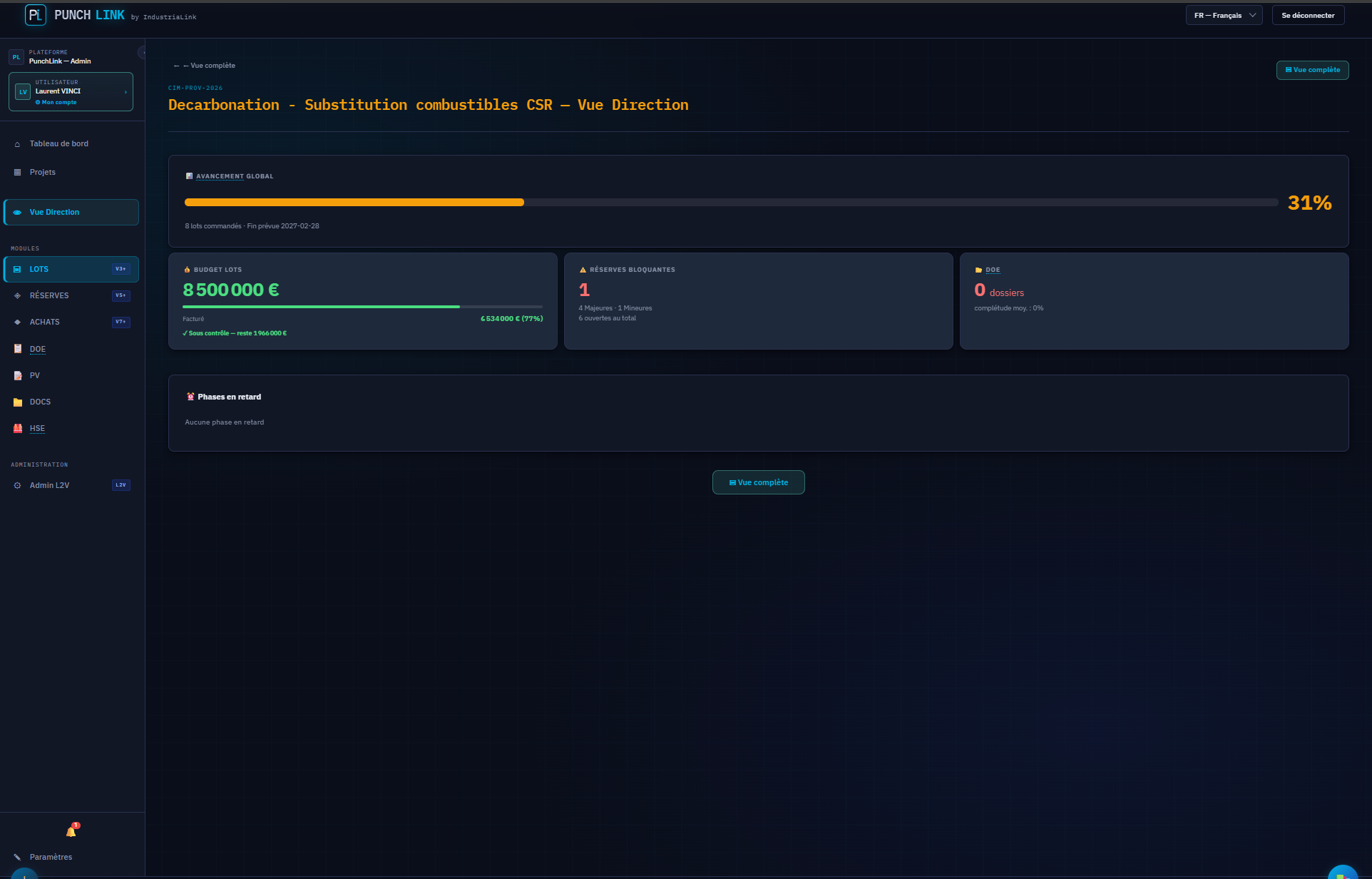
One view, the entire project
The screen the client reviews in the morning with their coffee. Physical progress weighted by budget, invoicing, performance bond retention, blocking reserves, DOE status — aggregated across 8 EPC packages in real time. No more Excel dashboard to rebuild every Friday.
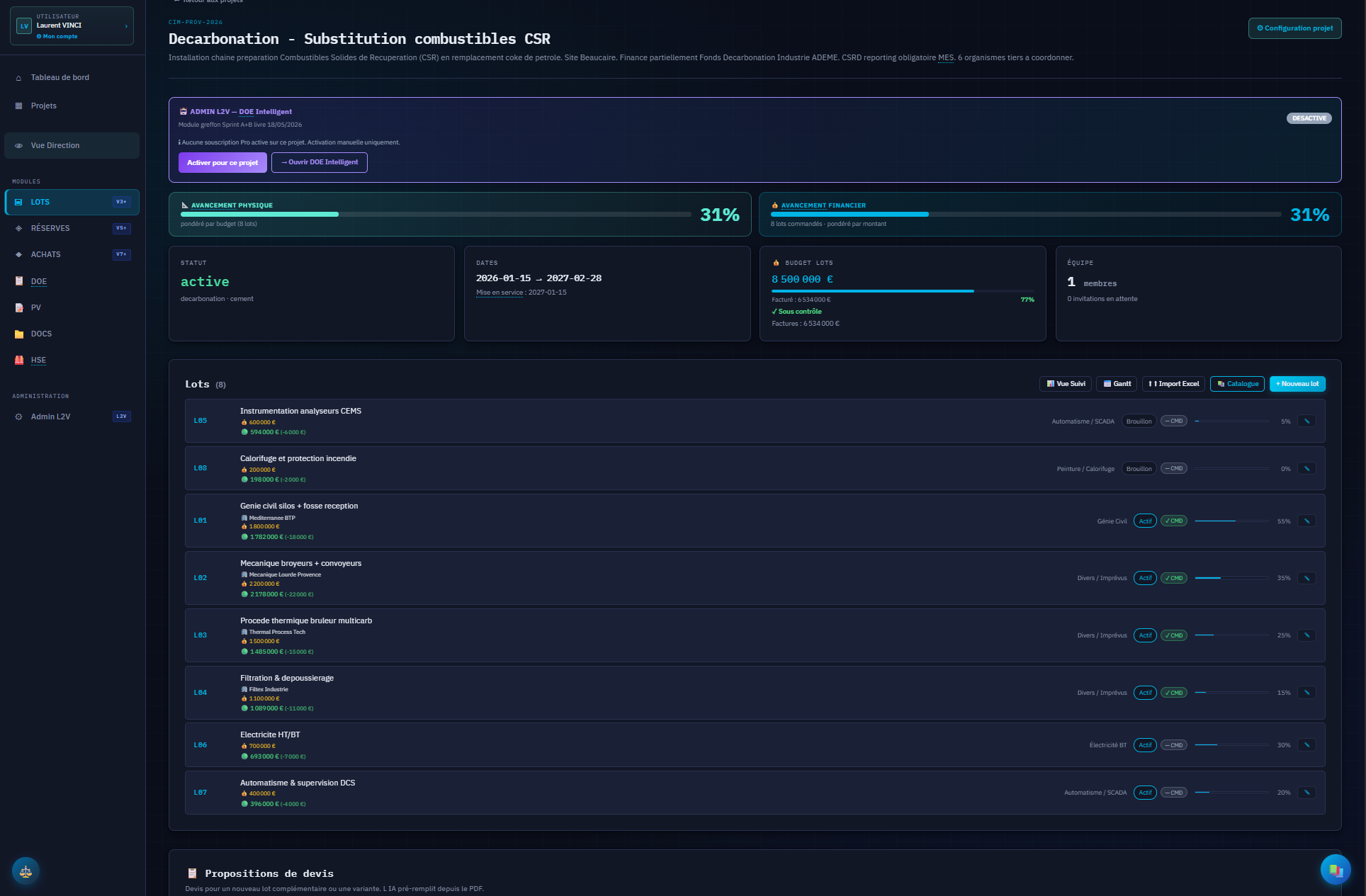
AFNOR P 03-001 applied automatically
For each package, net payable is calculated in real time: amount excl. tax × progress, minus blocking reserve retention (weighted), minus 5% performance bond. No more accountant interpreting the formula their own way — one calculation applied everywhere.
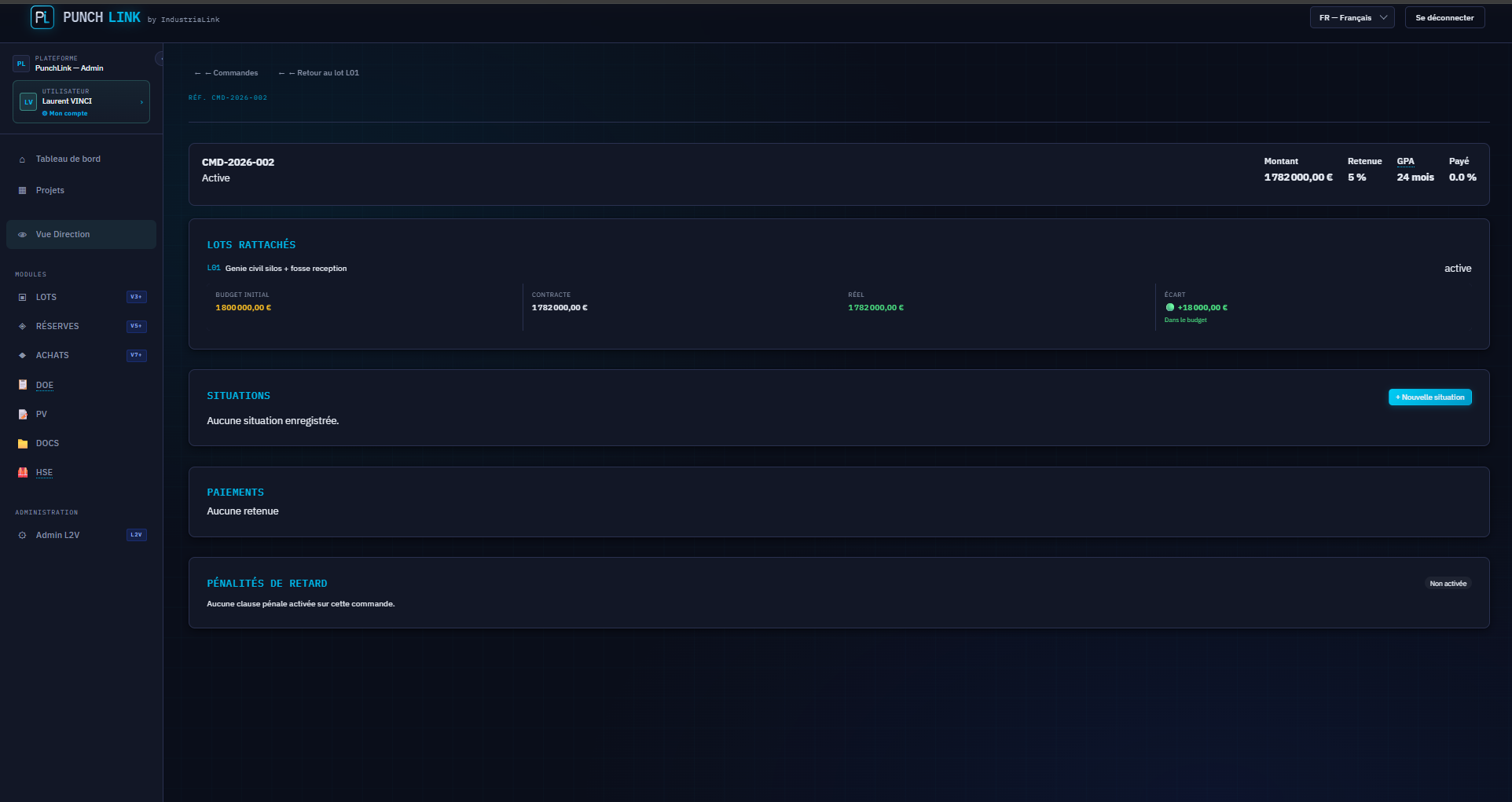
Industrial order, budget vs actual
For each order: initial budget, contracted amount, actual amount, real-time variance. The client immediately sees if the package stays within envelope or exceeds it, without waiting for monthly reporting. And the variance is sourced: change orders, extra costs, adjustments.
Biosourced insulation manufacturer · 2M€ EPC · 8 packages
Two neighboring industrial projects, launched 3 months apart in the same industrial basin. One managed on PunchLink, the other on Excel + WhatsApp. Here's what we observed after handover.
- DOE delivered in 2 weeks (vs 3 months market average)
- 92% of reserves closed within 14 days post-handover
- Startup advanced by one day vs planned date
- Clean startup, zero production stoppages in month 1
- No contractor payment disputes
- 3 months after project end to validate reserve closures and Final Delivery File (DFA) acceptance
- Startup delayed by 3 weeks vs plan
- Multiple production stoppages in months 1-3 — failures due to remaining unresolved reserves
- APAVE inspection stop for major non-conformity not caught at handover
Anonymized use case inspired by real industrial situations observed in the same basin in 2025-2026. Company names withheld for commercial confidentiality. Proprietary L2V SASU method — INPI prior-art filing.