
Why site financial holdbacks become unmanageable
On a typical industrial EPC project, the client accumulates several financial holdback mechanisms: 5% retention guarantee on each payment application, holdbacks on open blocking defects, and occasionally a contractual performance retention. Combined over 12 to 18 months of execution with 8 to 14 contractors, these mechanisms quickly become unmanageable when tracked on spreadsheets. Here's how it derails, and how to regain control.
The 3 holdback mechanisms on an industrial project
Mechanism 1: the retention guarantee
Standard on all industrial contracts: 5% of each payment application is retained by the client, accumulated in a dedicated account, and released in two stages. 50% at Provisional Acceptance (PA) if no major defects are open, 50% at Final Acceptance (FA) one year later, at the end of the warranty period (GPA).
For a 1.2 M€ contract, that's 60 k€ immobilized with the client for 12 to 24 months. For the contractor, it weighs on cash flow: they've paid suppliers and staff, but 5% of the contract doesn't come in. Across their full portfolio, this can represent 200 to 800 k€ of permanently blocked funds depending on company size.
Mechanism 2: holdback on blocking defects
On well-drafted contracts (AFNOR P 03-001), a standard formula applies to each payment application: net = gross × completion % − defect holdback (cumulative weighted %, capped at 100%) − retention guarantee. Concretely, if 3 blocking defects weight 15% of the lot, the payment is reduced by 15% pending their resolution. This is strong economic incentive to resolve quickly.
But this formula, applied manually on spreadsheets by an accountant or project manager, often produces inconsistent results: sometimes it's applied, sometimes forgotten; sometimes defect advancement is considered, sometimes not. The contractor loses confidence in the calculation, disputes it, and the relationship deteriorates.
Mechanism 3: performance retention (less common)
On EPC projects with contractual performance targets (plant throughput, efficiency, energy consumption), 5 to 10% of the contract value may be conditional on achieving measured performance during the Performance Test Run. It's released progressively based on ramp-up curves.
Why it becomes unmanageable
Cause 1: the formula is not applied systematically
Each accountant applies their own interpretation of AFNOR P 03-001. Some factor in advancement, others don't. Some cap at 100%, others let it exceed. Result: two consecutive payment applications from the same contractor may have different holdbacks for identical defects.
Cause 2: no traced release of retention
When a blocking defect is resolved, its holdback must be returned on the next payment application. Without automated tracking, it's easily forgotten. The contractor must request holdback release, justify, wait 4-6 weeks, and sometimes it gets lost in emails.
Cause 3: warranty period is not managed
Between PA and FA (one year later), the warranty period runs. The contractor must correct without additional cost all non-conformities flagged. Without a management tool, warranty notifications arrive by email, are handled by phone, and traceability disappears. At FA, it's unclear if all requested corrections were completed: conflicts over holdback release.
Cause 4: no contractor visibility
For a contractor managing 10-15 projects in parallel, tracking holdbacks on each becomes impossible manually. They can't precisely track how much is immobilized with each client, when it will be released, or how much they can count on for cash flow at 90 days.
The cost of deficient holdback management
The 4 conditions to regain control
- Single formula applied automatically on each payment application: net = gross × completion % − defect holdback − retention guarantee. No interpretation, no oversights.
- Traced and automated holdback release: once a blocking defect is resolved and validated by the client, its holdback is returned on the next payment application.
- Formalized warranty tracking with dates, notifications, resolutions, full audit trail through final acceptance.
- Contractor visibility with holdback amount by project, by phase, and projected release date.
How PunchLink addresses this
PunchLink natively integrates the AFNOR P 03-001 formula into payment application calculations. Each application is automatically generated from validated completion, applies blocking defect holdbacks (weighted by cumulative impact, capped at 100%), applies 5% retention guarantee, and proposes net payable to the client for approval.
An override "pay 100%" option remains available but with complete audit trail (user, timestamp, justification ≥ 50 characters). For the contractor, a dedicated view shows current holdback amount, broken down by project and reason (guarantee / defects / performance). For the client, holdback release is integrated into the defect resolution workflow: no oversights, no administrative delays. Retention of 10 years with the Archive option (industrial compliance).
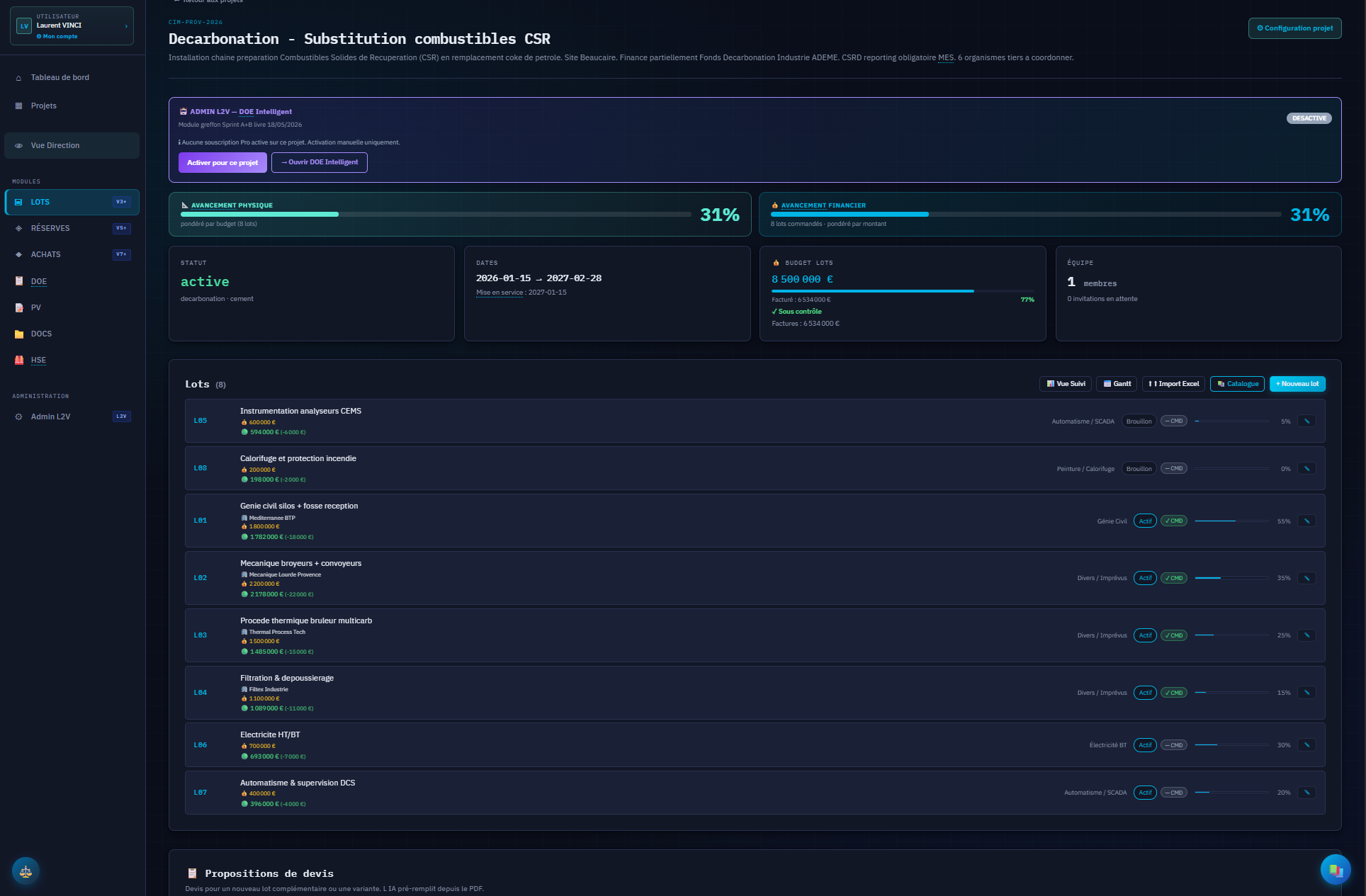
AFNOR P 03-001 applied automatically
On each lot, net payable is calculated in real time: amount HT × completion %, minus holdback on blocking defects (weighted impact), minus 5% retention guarantee. No accountant interpreting the formula differently — one formula applied everywhere.
Frequently Asked Questions
What exactly is the AFNOR P 03-001 formula?
On each situation: net payable = gross excl. VAT × % progress − reserve holdback (weighted cumulative %, capped at 100%) − guarantee retention (5% typically). Strict application is rare in practice on Excel-based sites.
What happens to guarantee retention after PR?
50% is released at Provisional Handover if no major reserves are open. The remaining 50% at Final Handover one year later, at end of DPA, provided no DPA corrections remain pending.
Can retention be replaced with a bank guarantee?
Yes, it is standard practice. The contractor provides a bank guarantee on first demand equivalent to 5% of the contract, as replacement for retention. The practice is increasingly common to preserve contractor cash flow.
How does PunchLink manage release of holdback?
Contradictory workflow: contractor lifts a reserve with photo, client validates; the associated retention is automatically returned on the next invoice. Complete audit trail: who validated, when, which photo, what justification.
What DPA monitoring one year after PR?
PunchLink traces all DPA reports (date, criticality, contractor involved, corrections made, client validation). At FH, client and contractor have a clear DPA status — no conflict over release of retention balance.