
The Hidden Cost of Failed Industrial Inspections
A failed industrial inspection is never just "one more day". It's a cascade starting with 30 blocking items no one saw coming, followed by unexpected demobilization of specialized teams, and ending in 3+ months of post-delivery catch-up while production runs partial. Here's how the hidden costs add up, and how to prevent the cascade.
What "failing" an inspection means
An industrial inspection is the moment the client signs the provisional inspection report (RP), which opens the one-year defects liability period (DLP), then 12 months later the final inspection (RD) legally closes the contract and releases retained funds. Any remaining open items must be closed between these two dates.
An inspection is called "failed" when the provisional report is signed with so many major and blocking open items that commissioning is at risk. On a French industrial project worth 5–20 M€, the critical threshold sits around 40–50 blocking open items on inspection day — beyond that, commissioning systematically runs 6+ weeks over plan, sometimes 3–6 months.
The 5 Hidden Cost Components
Cost 1: Forced remobilization of specialized trades
By inspection, contractor crews are already on the next job. Getting back a certified EN 1090 EXC3 welder, a Siemens TIA Portal automation engineer, an Endress+Hauser instrumentation technician — that takes 2–4 weeks to schedule. And it costs: €1,500–4,000 per day per trade, plus travel and accommodation.
Cost 2: Partial industrial restart
A facility due to start at 100% capacity runs at 60–70% for 4–12 weeks. For a plant generating €50k gross margin daily, that's €30–70k per week of lost margin. The operations team lacking complete procedures (because O&M manuals aren't delivered) makes more errors, extending the stabilization phase.
Cost 3: Contractual or commercial penalties
On well-drafted contracts (rare in SME work, common in EPCM with a main contractor), a delayed inspection triggers penalties of 0.5–2% of contract value per week, typically capped at 5–10% of total contract. On a €10M project, that's €50–200k per week in penalties, up to a €500k–1M cap.
Cost 4: Relationship cost with operations teams
A failed inspection damages the relationship between the project manager and operations. Operations teams — who waited 12–24 months to get a clean installation — inherit an unfinished site and must manage contractors trickling back. On major French industrial sites, this relational breakdown translates to lower tolerance on future projects in the following 12 months: less flexibility on change orders, tighter contracts, lost goodwill.
Cost 5: Administrative tail
For 3–6 months post-inspection, the project manager spends the equivalent of 15–25% of his time managing the fallout: tracking open items, chasing contractors, managing payment disputes, writing closure records. Direct cost (PM at €750–1,200/day loaded): €20–50k. Plus he's unavailable for the next project during this time.
Why so many inspections fail
Cause 1: No continuous tracking during construction
Site open items identified during execution are not systematically tracked and escalated. At inspection, you discover technical debt you didn't know existed.
Cause 2: As-built docs compiled at the last minute
The client discovers 4 days before inspection that O&M manuals, material certificates, NDT reports, test records aren't ready. But you can't reschedule an inspection coordinated by all operations teams: you sign with 60 documentation items open.
Cause 3: No progressive payment withhold
When payments flow 100% as work progresses with no progressive hold against open items, contractors have no incentive to close items quickly. They move to the next site and leave items dormant.
Cause 4: No contractual checklist by lot
The Mechanical Completion then Ready for Commissioning checklist isn't formalized by lot. You discover at MES that an isometric test or inspection record is missing. Too late.
The 4 Levers for Inspection Success
- Open items captured in real time, from site walk with photo. No hidden backlog.
- Continuous as-built compilation from day one, with automatic reminders to laggards.
- Automatic payment withhold against blocking items — economic incentive to close fast.
- Mechanical Completion + Commissioning checklist by lot, formalized, approved by workflow through client.
How PunchLink Delivers This
PunchLink covers the full inspection cycle: Mechanical Completion workflow by lot with multi-party sign-off (client, supervision, PM, contractor), contradictory punch list with mandatory photo, formal handover with auto-generated inspection report in Word, automatic link between phase approval and payment trigger.
A permanent "blocker items/HSE" banner on the Executive Dashboard shows inspection risk status. When signing the inspection report, the client sees at a glance how many items remain open, by lot, by criticality, and can decide with full visibility.
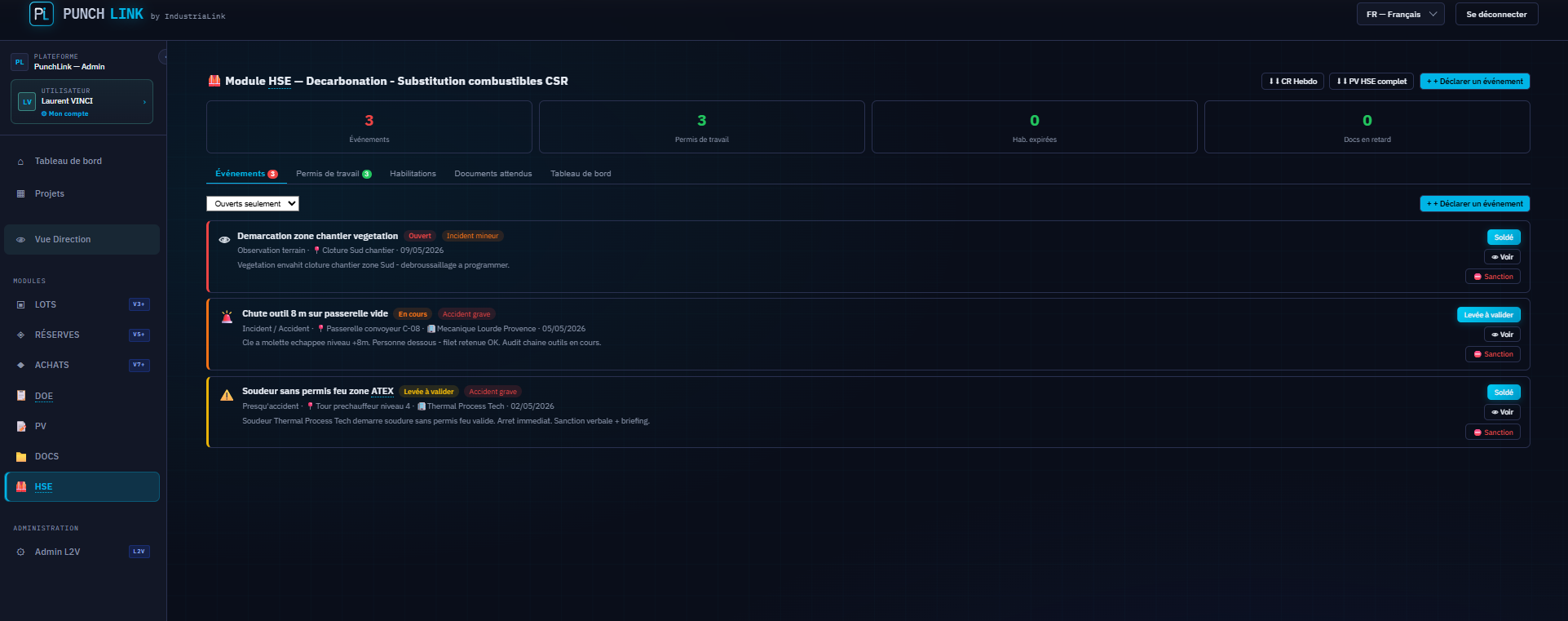
HSE Built In, Legally Defensible
A welder starts without valid hot work permit in ATEX zone. PunchLink logs the incident, triggers immediate stop, records the verbal sanction, archives the audit trail. Documentation ready for ICPE inspection, exclusion file exportable to Word — no manual paperwork.
Bio-based insulation manufacturer · €2M TCE · 8 lots
Two neighboring industrial projects, launched 3 months apart in the same region. One managed on PunchLink, the other on Excel + WhatsApp. Here's what was observed after handover.
- DOE delivered in 2 weeks (instead of 3 months market average)
- 92% of outstanding items cleared within 14 days post-handover
- Early start by one day versus planned date
- Clean commissioning, zero production downtime in month 1
- No contractor payment disputes
- 3 months after project completion to validate outstanding item clearance and Final Project Report (FPR)
- Commissioning delayed by 3 weeks versus schedule
- Multiple production stoppages in months 1-3 — failures due to uncleared outstanding items
- Third-party inspection stop for major non-conformity undetected at handover
Anonymized use case inspired by real industrial situations observed in the same region during 2025-2026. Company names withheld for commercial confidentiality reasons. L2V SASU proprietary method — INPI prior-art filing.
Frequently asked questions
At how many outstanding items is a handover considered "failed"?
It's more of an expert judgment than an absolute threshold, but field experience from French industrial sites with €5-20M TCE projects shows that beyond 40-50 blocking outstanding items open on handover day, commissioning systematically takes more than 6 additional weeks versus planned.
Can you refuse to sign a provisional handover report?
Yes, the project owner can refuse and require that critical blocking outstanding items be cleared before signature. But in practice, on a schedule-pressured site, you sign with a "subject to" report listing outstanding items to clear, rather than block commissioning.
What's the difference between provisional and final handover?
Provisional Handover opens the one-year defects liability period, starts operations, and releases 50% of retention. Final Handover one year later legally closes the contract and releases the remaining retention.
How does PunchLink prevent failed handovers?
Through a real-time Management Dashboard aggregating: weighted progress by lot, outstanding items by criticality, DOE status by lot, HSE status (valid permits, current certifications). The project owner sees technical debt before it becomes unmanageable.
How long before handover should you start preparing?
Ideally from Day 0 of the project, with continuous tracking. If not, 3 months before planned handover for a €5-20M TCE project — time needed to identify dormant outstanding items, chase lagging DOE, and arrive with a clean file.